

Interview with Saad Ghosn
Transcript
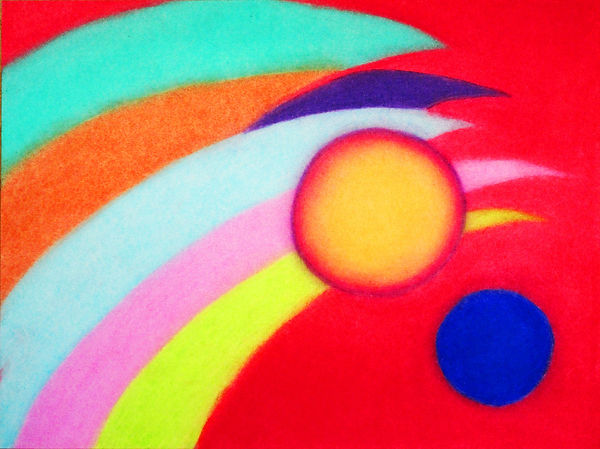
[00:02] Malia: How about we start with maybe, like, ‘Tell me about yourself,’ like, kind of your—
[00:07—01:30] Saad: Okay, my name is Saad Ghosn, I’m from Lebanon, I’ve been living here since 1976 in the United States. I’m a physician. I am a professor of medicine at UC, I retired, uh, eight years ago.
I’m a self-taught artist; I started drawing and creating art when I came to this country. I think I really needed initially, like, a therapeutic thing, you know, I was changing culture, I was in different environments, so it was good for me.
But then in 2001, I became very interested in art for social justice. And art, as the voice of the artist, or what’s important to the artist, not only art for the object, for the beauty, or color or the aspect of the object, but for how the art can reflect the artist, what the artist believes, their life, their uh...their values, what their emotions [are], so on. And so, I started doing this art myself, and I created in parallel SOS Art. It’s an organization that wants to promote, encourage, provide opportunities at venues for artists to use as their voice for peace and justice.
[01:31] Malia: Okay.
[01:33] Saad: And SOS Art was created in 2003, so it has been in existence now for twenty-one years.
[01:42] Malia: Do you remember, um...what month at all?
[01:45] Saad: What’s that?
[01:46] Malia: Do you remember what month it was-
[01:49] Saad: What month it was, uh, started?
[01:51] Malia: Yeah.
[01:52] Saad: I think it was, uh, May 2003.
[01:56] Malia: Okay.
[01:57] Saad: Why?
[01:58] Malia: Really the only reason I really asked is, that was the year I was born, so I was kind of like, trying to compare to see—
[02:04] Saad: Which year were you born? Which uh- which month?
[02:07] Malia: March.
[02:09] Saad: Actually, in reality it was really- it's good because it was triggered by the invasion of Iraq that occurred in March [2003]. This was a trigger, yeah.
-
I believe what he meant was that it was good that SOS Art was founded at the beginning of the war/invasion because it could give people impacted by that event something to channel their voices for peace and justice, as he said earlier.
[02:24] Malia: Yeah, I was kind of thinking about [the invasion], um, when you said [March 2003], but I wasn’t sure if that was really relevant to the conversation. Um...so, you mentioned you got into art when you, um, came over here, um...was it ever something you were interested in when you were younger?
-
When I said that first part, I meant that (at that point in time) I wasn’t sure if bringing up the Iraq invasion as a historical event was relevant to the interview because I didn’t realize it would actually be relevant- in hindsight I feel the need to clarify that I didn’t mean to sound rude.
[02:45] Saad: I think so. I was [?] in the arts. I never had the- the mean[s] to learn art. Our schools in Lebanon did not at all expose us to art. So, I didn’t get it, but when I came- when I left Lebanon, came here, I started creating.
[03:08] Malia: Got it. Um...so, I know you’re a medical [professor], did you- were you ever kind of like, skeptical of art before? I know a lot of doctors are kind of more logical.
[03:29] Saad: No, on the contrary. I all the time felt that art, uh, has a spiritual dimension, and it was really important because it can connect you above the material, so, no, I loved art all the time.
[03:46] Malia: Do you happen to remember if you had ever used, like, the [theme] of the circle before the pandemic? Or—
[03:53] Saad: As I- as I said you know, I used the circles in many, many of my art [pieces], [in] most of them there’s a circle and people ask me why, and as I said, you know, for me, the circle functions like an anchor in my image, so when I start it, I do a circle, it creates a balance in the drawing and around it, I create more. So, I’ve been all the time very much attracted to the circle, and I use it in many, many of them, yes.
[04:23] Malia: Have you noticed, um...a change, kind of, in your art from before the pandemic and now?
[04:34] Saad: No, not really. It hasn’t really affected my art. I would like to be more creative, unfortunately I haven’t been doing a lot of art because I’ve been doing all my other involvement with SOS Art, which occupies most of my time. But, uh, no. As I said I just came back from a trip from Crete, and I created different works in Crete, but also it includes circles in it.
[05:11] Malia: Oh, this is one I was excited to ask— so, I know a lot of like, younger artists kind of struggle with finding a style to kind of, like, use for their own, they’re kind of insecure about the fact that their style is really, like, inconsistent, do you, um— how did you develop yours?
[05:36] Saad: I think, you know, this is an important question because frequently, what makes you unique and different gives you an identity, is your style. And frequently you go to schools, people want to teach you, you know, all kinds of stuff, which is good because you’ll develop techniques in the beginning but frequently, they take away your style. They force you to do, oh, this, because, “This is pleasing, people like that,” or do [that]— I think the most important [thing] for an artist is to find their own way in which they want to present things, and it will be your style, and to develop it. For me, I think I had developed the style from a long time, which was my way of thinking, my own way of seeing...I didn’t have to, how do you say— “fight,” or to...struggle to find my own style. Now my style is different, you know, I mean, this is very different from the woodcuts, style-wise, but the woodcuts, if you see them, you’d recognize right away that these are mine, because it’s my style.
[06:46] Malia: Yeah. They’re very consistent, like I noticed there’s a lot of, like—
[06:50] Saad: Correct. Visually they are very consistent.
[06:55] Malia: Were there any artists that inspired you in particular? Did you ever study anyone else?
[07:02] Saad: No, no, not really. I liked many, many artists and I follow them, and um— there’s not one single person, you know? Many people I like, you know, but I like so many things. I’m not really a, you know [?], I like everyone. And, uh, I like some very contemporary [artists] and some classical, so it’s not— I’m not at all fixed on one style.
[07:24] Malia: Yeah, it’s not like, in a box.
[07:28] Saad: No, yeah.
[07:29] Malia: Got it. Was there something that happened that made you want to found SOS Art, like was there a specific event?
[07:41] Saad: Yeah, yeah, two things that had happened. One, in 2001— in April 2001— there were racial riots in Cincinnati.
[07:52] Malia: Oh, that’s right.
[07:53] Saad: Okay. And then, in September 2001, there was the, you know, what you call terrorist attacks of the 90 level. These two triggered a lot, for me, the need to create [SOS] Art, because I realized many artists did not have a venue to express their social and political views. The artists were doing art, you know, in college, by schools, by galleries— do art that pleases, do art that sells. And this took the artists away from themselves, as I was saying, “If you have strong feelings about social justice, how come I’m not seeing it in your work?” Your work after all is your expression, is your communication tool. And that’s what really forced me to start SOS Art.
[08:48] Malia: That makes sense. Any good advice that were you offered, if you ever— if you talked to other artists, if you had ever gone to any expos or other showings?
[09:15] Saad: Like I said earlier, you know, follow your heart. Do things for you, not for others, so when you create a piece, put yourself in touch with yourself and say, “What’s important for me to do for me?” Because if you do it this way, if it comes from your heart, it’s going to be truthful and it’s going to be strong. And then, it makes a difference, so, making a difference should be at the end, so, it would be like putting the cart before the horse. So, whether your piece [is pleasing] to others should be the last thing. The first thing it should be, it should be coming from your heart, it should please you. That’s what I tell artists— don’t really think about, you know, “When I do it, are people going to like it?” You shouldn’t care about that. You should care about, “Hey, this is important for me, I’m going to do it.” And once you do it, if it’s truthful, it’s going to please others.
[10:29] Malia: That’s— yeah, I feel the same way. Because I notice a lot of people on social media specifically will kind of— a lot of younger artists will get really discouraged because people will kind of be like, “Oh, well, this isn’t good, this isn’t—”
[10:45] Saad: Don’t listen to them. Don’t listen. If it responds to something important for you, it’s very good. That’s what counts.
[10:55] Malia: Right, exactly. I think I already know the answer to this because we just kind of talked about it a little bit, but I want to ask it in case there are people that read this article and they’re kind of like, “I don’t know, I’m not really ‘good’ at art.” Do you feel like it has to be “good” to be considered “real” art?
[11:19] Saad: Not at all, not at all. I think what’s really important that there is, within you, a truthful motivation for it. And you become good, you don’t have to be good— but, if you encourage yourself, give yourself the opportunity to do it, your voice is going to get stronger. I tell people, I tell young people, “Anything you want to do, you need to do it regularly,” because it grows. Your voice gets stronger. If you’re a singer, and if you go for a year without singing, your singing is going to go down. When you’re going to come back to it, it’s going to be harder. If you’re a runner, a sports person, if you don’t do it for a while— so, if you really feel that visual art, or poetry, or music is your way of expressing yourself, do it. And don’t worry about things in the beginning. You’re going to find, progressively throughout it gets better and stronger, and people, when you share it, are going to reply and want to respond to it. So yeah, that’s what I would say.
-
By “go down,” he means that skill (singing) will go down or become weaker due to a lack of practice.
[12:32] Malia: Do you— how do you work through art block? Is that something you kind of have happen to you every once in a while or is it—
[12:51] Saad: It does, it does. And uh, especially— there’s so much noise around you, you know, to be able to withdraw it is difficult for me, especially with SOS Art because all of my energy goes there, but as I told you, I just came back from these three weeks in Crete, where, because I was away from the noise, my creativity came. So give yourself time to meditate, find a place where you can isolate yourself and do it. That’s what you need. Think about it— don’t turn away from yourself. If you think about it, keep it in the back of your mind even if you don’t have an answer, but at least because it’s in the back of your mind, it’s going to mature, grow, and then when the time comes, it’s going to come out.
[14:09] Malia: You said something about color theory, I struggle with color theory all the time—
[14:15] Saad: You know about it?
[14:16] Malia: I have no idea how it works, I’ve heard people try to explain it, I still don’t know how it works, and I just kind of use whatever.
[14:26] Saad: All of these are tools, that if you master or if you learn can help you. I would like to get it, but you know, right now, I don’t, and maybe at some point I will. So, ideally, the art classes should give you tools to perfect your skills. But that’s it. They are tools. And if you think that the tool doesn’t work for you, if you’ll recreate it, you should, so don’t be dogmatic about it. And that’s what I’m saying, is I’m not dogmatic about these colors. They worked for me, because they worked for me.
[15:03] Malia: Right, they were fun to use.
[15:05] Saad: Yeah.
[15:03] Malia: Was there a process you went through to kind of find what materials you like to use? Like, how did you find out that you liked doing the woodcuts?
[15:23] Saad: You see, the woodcuts— it’s a good question because before the [?] I was really drawing and painting. The woodcuts are immediate and the fact of carving is therapeutic, and then they lend themselves because they are stark, the message is direct, it’s black-and-white, it’s simplified. They lend themselves very much to social justice messages and many artists use them that way. For instance, Sogoya, Käthe Kollwitz, here, Tom Sho— you know, many artists that use their art for social justice used woodcuts because of the immediate effect, they’re stark, they are direct. The image is simplified in a way, so…
-
I tried searching for the artists based off the phonetics in the recording, but I could only find Käthe, so I’m not sure I spelled them right.
[16:17] Malia: That makes sense, ok. I think that’s about it.
[16:19] Saad: Okay. Well, if you think of others, feel free to write to me, and again if you want to include some of these images, take a picture with your camera, send them to me, and I will send you a good version of it.
[16:38] Malia: Okay, sounds good.
[16:40] Saad: Thank you, Malia.
[16:41] Malia: Yeah, thank you!
[16:45] Saad: And keep me posted, tell me when it will be published.
[16:47] Malia: I will, yeah.
[16:48] Saad: Thank you so much.
[16:49] Malia: Yeah, no problem!

Saad Ghosn, a native of Lebanon, has been living in Cincinnati since 1985. A retired medical professional and educator, a Professor Emeritus of Medicine at the University of Cincinnati, Saad resorts to visual and spoken art to express himself and convey his social and political views. Saad strongly believes that activism is at the heart of art expression.
